Ask Engine Optimization One Year Later: What We’re Seeing in the Age of AI Search
Over a year ago, I wrote a blog introducing a concept I called Ask Engine Optimization (AEO). At the time,


Artificial intelligence has completely changed the creative world.
Today, businesses can generate logos, vehicle wrap concepts, sign mockups, and marketing graphics in seconds using AI tools. In many ways, that is incredibly exciting. At Blue River Digital, we are seeing more and more customers bring us AI-generated artwork for vehicle graphics, signage, apparel, promotional materials, and even logo design.
And honestly, some of the ideas are really impressive.
AI tools can be extremely helpful for generating inspiration, visual direction, mood boards, concepts, and creative starting points. They allow businesses to quickly explore styles, layouts, colors, and ideas they may have struggled to communicate otherwise.
But there is also an important reality that many businesses do not realize until they are ready to print.
Just because artwork looks good on a screen does not necessarily mean it is production-ready.
That is where professional graphic design and production preparation still matter tremendously.
One of the most common issues we run into with AI-generated graphics is scalability.
Most AI-generated artwork is created as raster-based imagery rather than vector artwork. That means the image is essentially made up of pixels instead of mathematically scalable shapes and lines.
For smaller uses like:
AI-generated graphics may work perfectly fine.
But once you try to enlarge that same artwork for:
the limitations begin to show quickly.
Images may become blurry, soft, pixelated, distorted, or inconsistent because they were never created to scale to those larger physical sizes.
A logo that looks sharp on Instagram may completely fall apart when stretched across the side of an enclosed trailer or a 4×8 roadside sign.
Professional print production relies heavily on vector artwork because vector files can scale infinitely without losing quality.
Vector artwork is commonly created in programs such as:
These files are typically saved as:
Vector graphics allow us to:
Without vector artwork, production becomes much more difficult and sometimes impossible depending on the application.
Another common issue with AI-generated artwork is the heavy use of:
These effects often look incredible in AI-generated previews, but they can become difficult or expensive to reproduce consistently in real-world production.
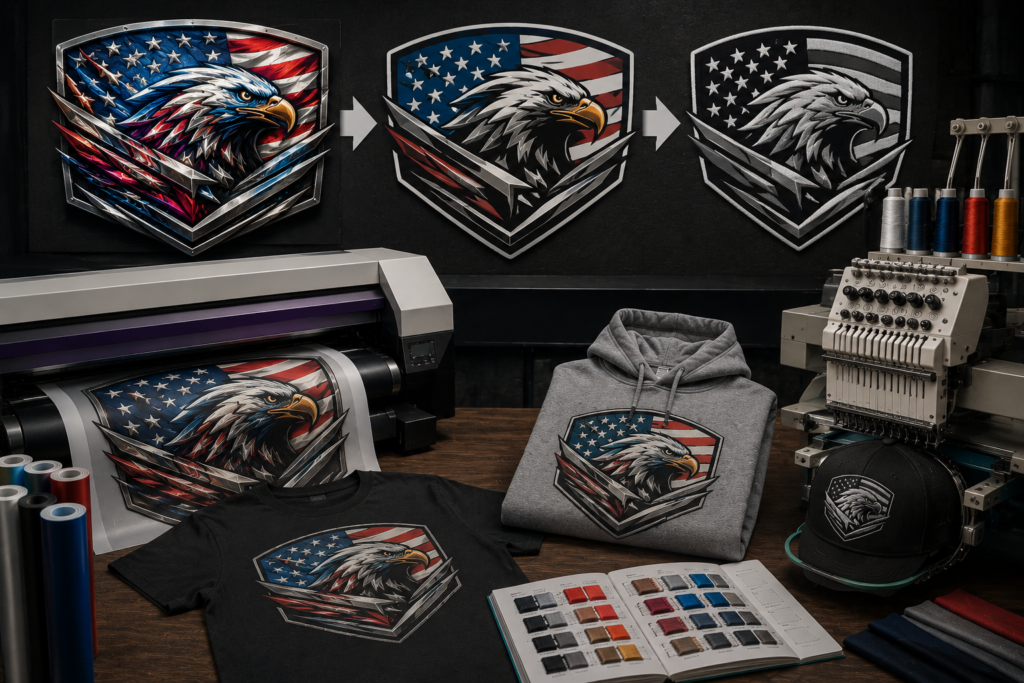
For example:
Vehicle graphics and signage especially require designs that remain readable and visually effective from a distance. Sometimes that means simplifying artwork so it performs better in the real world rather than trying to replicate every effect exactly as generated by AI.
Even with those limitations, AI still provides tremendous value in the creative process.
In fact, one of the best ways to use AI-generated artwork is as a direction-setting tool.
AI can help businesses:
Instead of viewing AI as the final design solution, we often encourage businesses to use it as part of the creative discovery process.
Then, our graphic design team can take those ideas and recreate them properly using professional design software and production-ready methods.
That approach typically creates much stronger long-term results while avoiding production problems later.
One of the most important things businesses should understand is that design requirements change depending on how the artwork will actually be used.
A design that works perfectly for:
may not work well for:
For example:
That is why professional production design still matters, even in the age of AI-generated artwork.
At Blue River Digital, we work with businesses every day that bring us AI-generated concepts, logos, and creative ideas.
Our goal is not to discourage the use of AI. In many ways, we believe AI tools are becoming an incredibly valuable part of the creative process.
What we help businesses understand is where AI inspiration ends and production-ready design begins.
Our graphic design team can help:
Sometimes the AI-generated artwork can be used almost immediately. Other times, significant recreation work may be required depending on how the artwork needs to be used.
The important thing is planning for the final application before production begins.
AI-generated artwork is opening up exciting creative possibilities for businesses everywhere.
But when it comes to real-world production like vehicle wraps, signage, apparel, and large-format graphics, professional design preparation still matters tremendously.
The best results often come from combining the creativity and inspiration of AI tools with the experience of professional graphic designers who understand production methods, scalability, readability, and long-term brand consistency.
If you are unsure whether your AI-generated artwork is ready for production, our team at Blue River Digital would be happy to help review your files, explain your options, and recommend the best path forward for your project.
Over a year ago, I wrote a blog introducing a concept I called Ask Engine Optimization (AEO). At the time,

One of the most common things we notice when reviewing Google Analytics reports for new customers is an unusually high